
Un savon conçu par des étudiants
Associant des ingrédients emblématiques de ses campus et reflétant la richesse et la singularité de l’école.
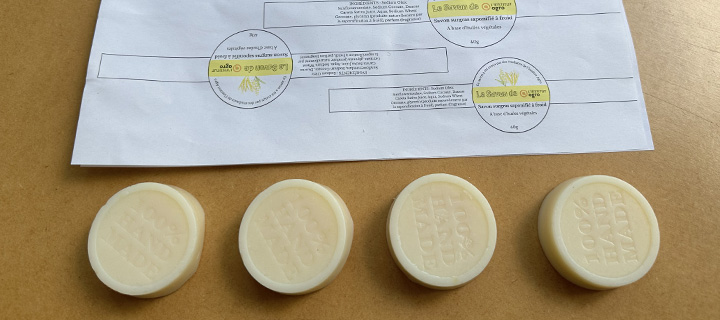
Conçu et fabriqué par des étudiants, il a été réalisé en laboratoire dans le cadre de leurs projets d’ingénieurs et incarne leur savoir-faire scientifique et leur engagement. Issu de ce projet étudiant, le savon sera offert aux partenaires de l’école ainsi qu’aux délégations étrangères accueillies sur les campus. Objet à la fois utile et symbolique, il porte les valeurs de l’Institut Agro Rennes-Angers : innovation, engagement, excellence académique et ouverture à l’international.
Une composition à l’image de l’école
Son parfum s’inspire de la rose Agrocampus Ouest, une variété commandée en 2008 lors d’une collaboration entre l’école — anciennement Agrocampus Ouest — et M. Michel Adam, pépiniériste spécialisé dans la sélection et l’amélioration des rosiers. Cette rose symbolise le lien entre tradition et innovation.
La carotte est beaucoup étudiée sur le campus d’Angers dans le Centre de ressources biologiques carottes et autres apiacées légumières, dédié à la conservation et à la caractérisation de la biodiversité des plantes de la famille des apiacées. Elle s’avère également être un excellent colorant naturel grâce à sa teneur en bêta-carotène, donnant au savon sa belle couleur jaune.
Ce savon aux huiles végétales contient aussi de l’huile de germes de blé, issue d’une culture céréalière largement présente en France et étudiée au sein du pôle végétal de l’Institut Agro, dans l’unité mixte de recherche IGEPP (Institut de Génétique, Environnement et Protection des Plantes). Elle est appréciée pour sa richesse en vitamine E, un antioxydant naturel, et permet d’obtenir un savon particulièrement doux et hydratant.
Un procédé qui respecte la peau et l’environnement
C’est un savon surgras issu d’un processus artisanal : la saponification à froid. Cette méthode confère au savon des propriétés nourrissantes et hydratantes, tout en ayant un impact environnemental faible, puisqu’elle nécessite peu d’eau et d’énergie.
------
Designed and crafted by students, it was made in the laboratory as part of their engineering projects, reflecting their scientific expertise and commitment. As part of this student project, the soap will be offered to the school’s partners as well as to foreign delegations visiting the campuses. Both practical and symbolic, it embodies the values of Institut Agro Rennes-Angers: innovation, engagement, academic excellence, and international openness.
A composition reflecting the identity of the school:
Its fragrance is inspired by the Agrocampus Ouest rose, a variety born from a collaboration between the school — formerly Agrocampus Ouest, before its integration into Institut Agro alongside the Montpellier and Dijon campuses — and Mr. Michel Adam, a nurseryman specialized in the selection and improvement of roses. This rose symbolizes the link between tradition and innovation.
Institut Agro Rennes–Angers is a school based on two complementary campuses, in Angers and in Rennes, and this soap is a fine illustration of that: it brings together emblematic ingredients from each of the sites.
Carrot is extensively studied on the Angers campus within the Carrot and Other Vegetable Apiaceae Biological Resource Center, dedicated to conserving and characterizing the biodiversity of plants in the Apiaceae family. It also happens to be an excellent natural colorant thanks to its high beta-carotene content, giving the soap its beautiful yellow color.
This vegetable-oil-based soap also contains wheat germ oil, derived from a cereal crop widely grown in France and studied within the plant sciences division of Institut Agro, in the IGEPP Joint Research Unit (Institute of Genetics, Environment and Plant Protection). It is valued for its richness in vitamin E, a natural antioxidant, and contributes to a particularly gentle and moisturizing soap.
A process that respects both skin and environment
This superfatted soap is produced using an artisanal method: cold-process saponification. This technique gives the soap nourishing and moisturizing properties, while maintaining a low environmental impact, as it requires very little water and energy.